
PF21B-900A is diffuse photoelectric sensor and detection distance 5~900mm
response time<50ms
switch frequency 10Hz


Search HistoryClear all records
Display up to 8 search history records~
全部
- 全部
- 产品管理
- 新闻资讯
- 介绍内容
- 企业网点
- 常见问题
- 企业视频
- 企业图册
News Details
11
2025
-
04
What sensors are used in miniload stacker cranes to improve positioning accuracy?
By using G-TEK brand photoelectric sensors to detect the relative positions of the loading platform, forks, bins, and shelves during the picking and unloading process, the stacker crane can achieve relatively stable movement during picking and unloading, avoiding collisions with forks and bins, and reducing the economic losses

Miniload stacker cranes( box stacker cranes) are developing rapidly in the industries such as food processing, medicine, and tobacco.
What are the advantages of miniload box stacker cranes for 3D intelligent warehouse?
(1) The miniload stacker cranes enable fast access to goods, significantly reducing storage and retrieval time and improving warehousing efficiency. The configuration and expansion of this system have great flexibility, whether it's the expansion of warehouse scale or changes in the types of items accessed, they can be adapted through the addition or adjustment of system modules. In addition, the intelligent stereoscopic warehouse system can quickly adjust storage strategies according to business needs, support multi variety and small batch production modes, and enhance the market responsiveness of enterprises.
(2) Miniload stacker crane integrates IoT, big data, and artificial intelligence technologies, enabling seamless integration with other warehouse management systems and real-time data sharing, achieving more intelligent management.
(3) The intelligent three-dimensional warehouse fully utilizes the vertical space of the warehouse, and achieves efficient storage and transportation of goods through intelligent stacker cranes and automatic conveying equipment. Saved storage space.
(4) Automated equipment replaces manual operations, achieving automation and intelligence in the processes of goods storage, handling, sorting, etc., greatly improving operational efficiency while reducing labor costs and operational risks. It has high reliability and low maintenance costs.

How can miniload stack cranes improve positioning accuracy?—— photoelectric sensor
The key requirements of miniload stack cranes for users are inventory level, inventory efficiency, and equipment stability. In order to meet these conditions, manufacturers need to highly integrate the stacker crane, reduce the movement space of aisle and fork, and improve the operating speed of the stacker crane. At the same time, manufacturers also need to consider costs and construction difficulties. To run quickly, good braking force is required, which also brings about the problem of loading and unloading positioning. If the positioning is inaccurate, it may cause collisions with forks and material boxes, affecting the subsequent logistics progress. In severe cases, material boxes, products, and equipment parts may fall from high places and cause harm to maintenance personnel. To avoid such problems, a position detection system for a stacker crane is necessary.
A photoelectric sensor is very suitable for position detection. Photoelectric proximity sensors have lower costs than visual inspection systems, and as long as they are designed properly, they can achieve the same or even better results as visual inspection systems. Moreover, the photoelectric sensor occupies a small space and can be integrated onto the fork, saving the movement space of the fork and improving the space utilization of the miniload stacker crane.
How to choose a suitable photoelectric sensor?
In order to meet the integration needs of stacker crane forks, the following is selected: G-TEK brand diffuse photoelectric proximity sensor PF21B-900A,PF21B-350A and PF21T15M.
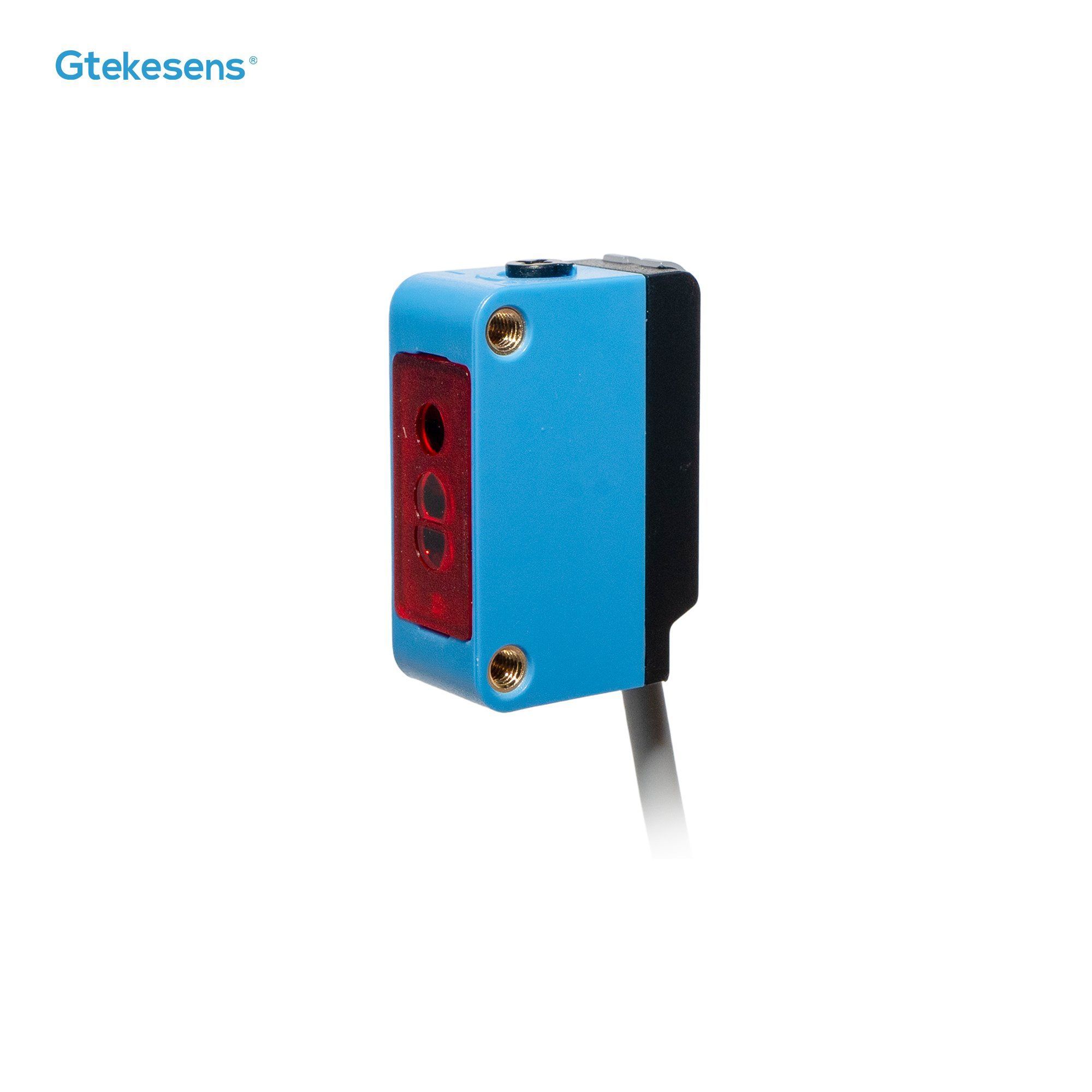
PF21B-350A is diffused photocell sensor and max. detection distance 350mm
response time <2.5ms
switch frequency 200Hz
PF21T15M is through-beam photoelectric sensor and max. sensing distance 15m
response time <5ms
switch frequency 100Hz

Above sensors have visible light spot for easy to align, small size and easy to install.
The products are able to replace international brands with high cost-effective and efficient performance.
Miniload stacker crane picking and unloading solution
Installation location (as shown in the figure)
① The cargo detection photoelectric sensor is located in the middle of the cargo platform;
② Photoelectric sensor for cargo detection on the right shelf at the rear right of the loading platform;
③ Photoelectric sensor for detecting the presence of goods on the left shelf behind the loading platform;
④ Detect any movement in the position of the cargo box on the right rear side above the loading platform;
⑤ Detect any movement in the position of the cargo box on the left rear side above the loading platform;
⑥The right side of the fork indicates whether there is cargo detection on the right side of the inner fork;
⑦ The left side of the fork indicates whether there is cargo detection on the left side of the fork;
⑧ Through-beam photoelectric sensor, used to detect a group of forks on the far right side of the fork and the far right side of the loading platform are centered and extend beyond the fork to the right;
⑨ The opposing sensor is used to detect the center and left corner of a group of forks on the leftmost side of the fork and the leftmost side of the loading platform.


By using photoelectric sensors to detect the relative positions of the loading platform, forks, bins, and shelves during the picking and unloading process, the stacker crane can achieve relatively stable movement during picking and unloading, avoiding collisions with forks and bins, and reducing the economic losses


Contact Information
Add: No.6 Guangyuan Road , Zhajiawo Town Xiqing Dist ,Tianjin, China
Tel: +86-13682005660
E-mail: export@gtekautomation.com